
Choosing the best wearable for HRV accuracy isn’t just a spec question. The answer depends on when you’re measuring, how hard you train, and what you’re actually trying to learn.
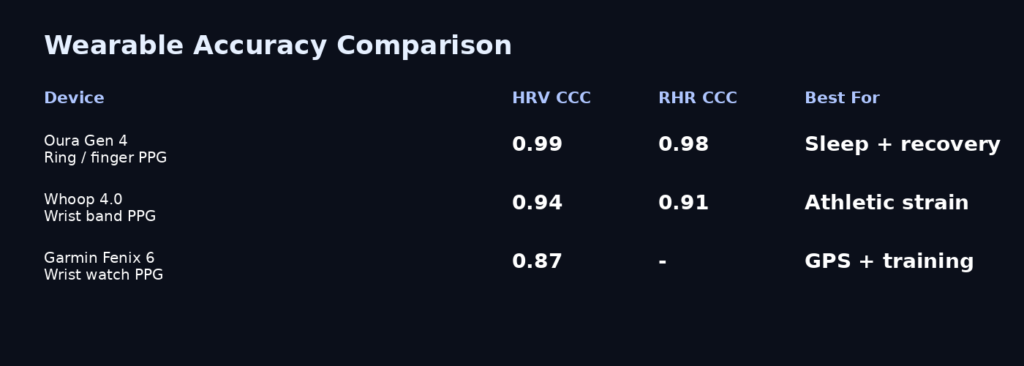
The best wearable for HRV accuracy is not the one with the most features — it’s the one that measures in the right place, at the right time, in a way that reflects your actual nervous system state. As we covered in What Wearables Can and Can’t Tell You About Your Nervous System, all three devices are capturing the same underlying metric — nocturnal RMSSD — but the precision with which they do so varies significantly between brands, and for reasons that matter.
Why HRV accuracy differs between wearable devices
The gap between devices comes down to two things: sensor placement and proprietary algorithms. Every wearable on this list uses photoplethysmography (PPG) — an optical sensor that measures blood volume changes to infer heart rate and HRV. But a finger is not a wrist. The fingertip has denser vasculature closer to the surface, producing a cleaner, more stable signal with less motion artefact during sleep. This is the primary physical reason Oura consistently outperforms wrist-based devices in nocturnal accuracy.
The independent Dial et al. 2025 validation study — 536 nights of sleep data measured against an ECG reference — confirmed this precisely. Oura Gen 4 achieved a near-perfect concordance correlation coefficient of 0.99 for HRV. Whoop 4.0 showed moderate agreement at 0.94. The Garmin Fenix 6 returned poor agreement at 0.87 and was excluded from resting heart rate analysis entirely due to methodological inconsistencies in how it reports the metric. Each brand also runs proprietary algorithms over the same raw PPG data — meaning two devices on the same wrist can legitimately disagree, not because either is broken, but because they weight different windows of sleep when computing the final number.
“The accuracy rankings flip depending on what you’re measuring and when. Oura leads at rest. Whoop leads during athletic recovery. Garmin leads when you’re moving.”
Where each device actually wins for nervous system tracking
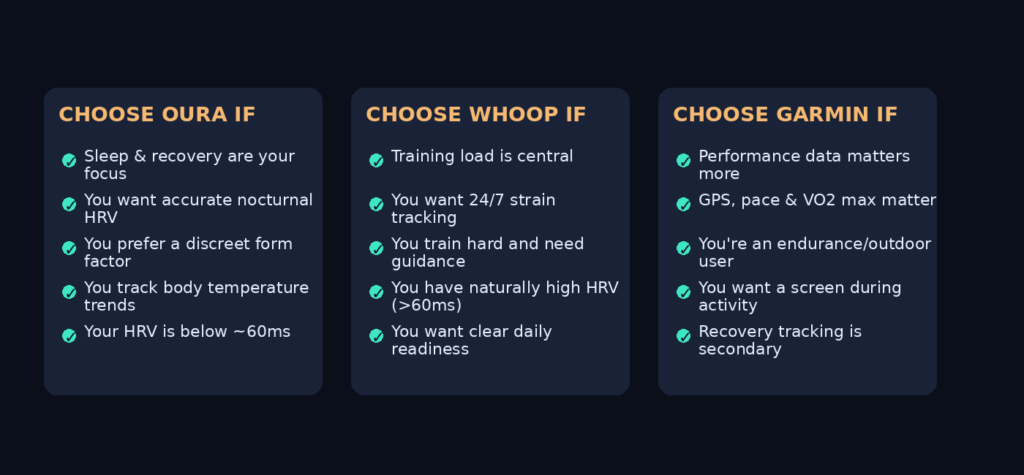
The headline accuracy numbers are nocturnal. But nervous system tracking doesn’t stop at sleep. HRV4Training’s independent analysis of the Dial study flags a nuance that the raw numbers miss: at higher HRV levels above roughly 60ms, Oura’s deviation from the ECG reference increases — meaning naturally high-HRV athletes may find Whoop’s readings more reliable. And for exercise heart rate monitoring specifically, the ranking inverts entirely: Whoop outperforms Oura, and Garmin outperforms Whoop. What this means practically is that device choice should follow use case, not a single accuracy table.
The most accurate device is only as useful as what you do with the data
Device choice matters, but it matters less than most people think. The gap between Oura at 0.99 and Whoop at 0.94 is real but not transformative for everyday practice. What is transformative is how you read the data once you have it. A 30-day personal baseline, tracked consistently, tells you far more than any single reading — and the device that most fits your daily life is the one most likely to stay on your wrist. As the research on what consistent daily practice does to your ANS shows, HRV improvements from meditation and breathwork emerge over 7–10 days and persist between sessions. The right wearable is the one that’s there to detect that signal — whichever one you’ll actually wear.
Leave a Reply