
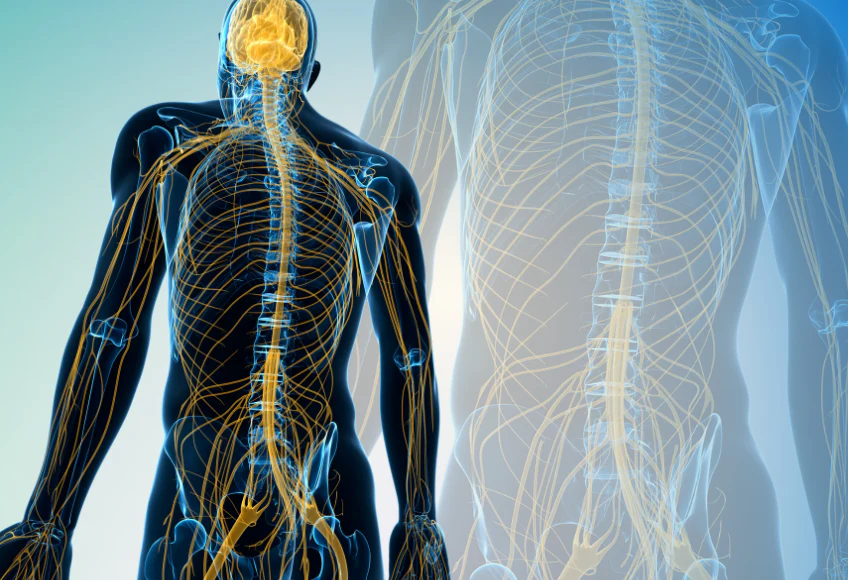
Every time someone tells you to take a breath when you’re stressed, they mean well, but they’re leaving out the most important half. The inhale is the windup. The exhale is the pitch — the moment when your nervous system actually shifts gears. Understanding why changes everything about how you breathe on purpose.
The Heart Listens to Your Lungs
Your heart rate isn’t constant. It rises slightly with every inhale and falls with every exhale, a phenomenon called respiratory sinus arrhythmia (RSA). This isn’t a glitch — it’s design. During inhalation, activity in the vagus nerve temporarily decreases, allowing heart rate to climb. During exhalation, vagal activity surges back, pulling the rate down. The whole oscillation is a continuous conversation between your lungs, your brainstem, and your heart.
The vagus nerve is the primary highway of the parasympathetic nervous system — the branch responsible for rest, digestion, and recovery. When it fires, your heart slows, blood pressure softens, and your body begins the long exhale of physiological restoration. You cannot force this response by willing yourself calm. But you can summon it, reliably, through the length of your exhale.
The vagus nerve doesn’t wait for permission — it waits for the exhale.
Pulling the Lever Deliberately
Slow-paced breathing — typically around six cycles per minute, five seconds in and five seconds out — sits near what researchers call resonance frequency: the breathing rate at which RSA amplitude peaks and heart rate variability (HRV) spikes. At this pace, the oscillations of inhale and exhale align with the natural rhythm of cardiovascular regulation, creating an amplified call-and-response between lungs and heart.
A 2025 pilot study published in Physiology & Behavior found that both slow-paced breathing and humming breathing produced significantly higher SDNN and total power HRV values compared to rest, with large effect sizes across autonomic measures. The mechanism isn’t mysterious: a longer, controlled exhale gives the vagus nerve more time to modulate cardiac output. The signal gets louder. The nervous system listens.
This is why a five-second exhale does something a two-second exhale doesn’t. Duration isn’t preference — it’s the dose.
What Changes Over Time
HRV isn’t only a snapshot of your current state. It’s also a measure of how trainable your autonomic nervous system is. People who practise slow-paced breathing consistently — even ten minutes a day — tend to show elevated resting HRV over weeks, reflecting improved vagal tone: a more responsive, more flexible nervous system.
Flexibility matters more than absolute numbers. A nervous system that can mobilise under pressure and return to baseline efficiently afterward is what resilience actually looks like in the body. Not stillness. Not the absence of activation. The capacity to complete the cycle.
The exhale doesn’t switch off your stress response. It gives your vagus nerve the window it needs to do its job. That job has always been yours to support — most people just forget to slow down on the way out.