
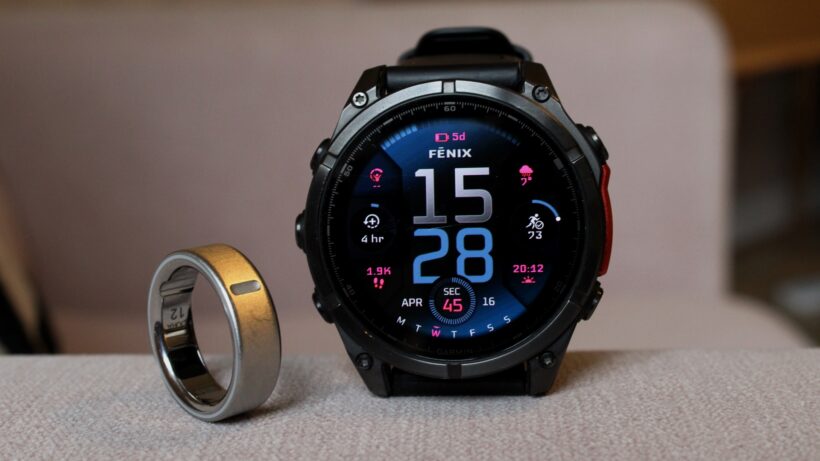
How Garmin HRV Status reads your nervous system differently from Oura Readiness
Garmin HRV Status delivers a categorical verdict rather than a continuous score. Garmin’s HRV Status documentation explains the five categories: Balanced means your HRV sits within your personal normal range. Unbalanced (above baseline) can indicate overtraining or incoming illness as much as fitness improvement. Low signals a meaningful drop below baseline — reduced parasympathetic tone, less ANS flexibility. Poor reflects an extended period of suppressed HRV. The label system is intentionally simple — useful for quick daily decisions without requiring the user to interpret a raw number.
Oura’s Readiness Score takes a different approach entirely. It combines HRV balance, resting heart rate, body temperature, sleep score, and activity balance into a 0–100 composite with a contributor breakdown that shows exactly which factors pushed the score up or down. The transparency is a genuine advantage: a Readiness score of 62 with a low HRV contribution and a high sleep score tells you something specific about where your nervous system struggled versus where it succeeded. Tom’s Guide’s HRV Status explainer notes the core ANS link: your HRV score shows how well your body adapts to different challenges — both systems encode this, but Oura shows you the anatomy of it.
As we explored in our wearable HRV guide, every consumer device measures RMSSD during sleep and compares it to a personal baseline. What differs is the calculation window, the output format, and — critically — what else gets folded into the final readout.
“Garmin HRV Status gives you a verdict. Oura Readiness shows you the reasoning. Which matters more depends on whether you’re making a quick decision or understanding a trend.”
Choose Garmin HRV Status if: You already use a Garmin and want fast daily guidance. The five-category label integrates into Garmin’s training ecosystem — Training Readiness, Body Battery, and Health Status all reference it. No extra device needed.
Choose Oura Readiness if: You want the most accurate HRV data with contributor detail. Finger-based PPG outperforms wrist at rest. The contributor breakdown gives you a diagnostic layer that Garmin’s categorical output doesn’t provide.
What both scores agree on — and where that agreement matters
Despite their methodological differences, Garmin HRV Status and Oura Readiness converge on the same underlying principle: your personal baseline is the only meaningful reference. Neither compares you to a population average. Both require weeks of consistent overnight wear to establish a personal normal range. Both treat deviations from that range — not absolute HRV values — as the actionable signal.
That shared principle is the most important feature either offers. A single HRV reading tells you almost nothing. A pattern of HRV relative to your own history tells you everything your nervous system is trying to communicate about its current recovery state.
Science sources
Leave a Reply