
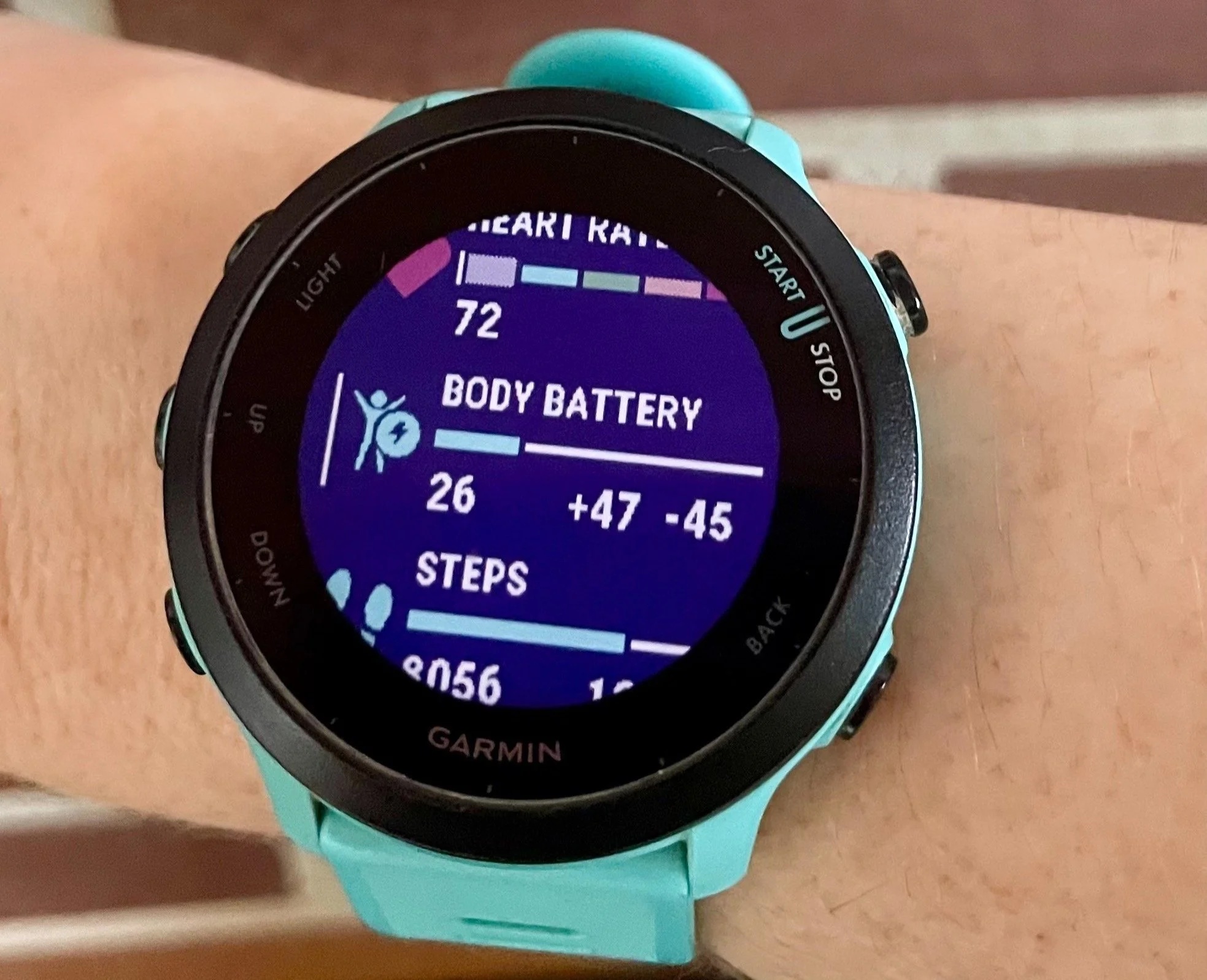
How the Garmin Body Battery nervous system model actually works
Garmin built Body Battery on top of its Firstbeat Analytics engine — a Finnish biometrics firm whose physiological models underpin Garmin’s HRV Status, Training Readiness, and stress scoring. Garmin’s own documentation confirms the mechanism: the score reflects your physical activity, stress, rest, and sleep — and how each impacts your energy levels in real time. HRV during sleep determines the overnight recharge ceiling. Garmin’s stress score — itself derived from HRV suppression relative to your baseline — drains the battery continuously when elevated. Physical activity draws an additional charge based on intensity. The result is a live 1–100 number that moves throughout the day as these inputs combine.
The ANS logic is precise. When your sympathetic system runs high — elevated cortisol, suppressed HRV, background stress activation — the model reads this as drain rather than recovery. When your parasympathetic system asserts overnight — HRV rises, resting heart rate falls, sleep stages deepen — the model reads this as recharge. Garmin’s Singapore team explains it directly: changes in HRV status reveal how well your body responds to stress and relaxation — shifts in HRV provide the basis for stress tracking, Body Battery monitoring, and sleep tracking simultaneously.
The four inputs that build your Body Battery score:
HRV overnight (primary) — The core signal. Beat-to-beat variability during sleep encodes ANS recovery state and drives the score more than any other input.
Stress response (drainer) — Garmin’s 0–100 stress reading (HRV-derived) depletes the battery in real time. High stress = fast drain.
Physical activity (drainer) — Exercise, steps, and active minutes draw from the battery. Intensity matters more than duration.
Sleep quality (recharger) — The primary recharge mechanism. Deep and REM sleep rebuild the battery fastest.
“Body Battery is a real-time look at your personal energy resources — it helps you connect the dots between stress, recovery, sleep and physical activity.” — Garmin
What Body Battery can tell you that raw HRV cannot
Raw HRV gives you a static overnight snapshot — useful, but it doesn’t capture what happens to your recovery reserves across the day. Body Battery adds the temporal dimension: how fast your battery drains under stress, how quickly it rebuilds during low-activity periods, and whether your overnight recharge actually brought you back to baseline.
The most actionable use of Body Battery for nervous system awareness is tracking drain velocity. As we explored in Stress Is Not the Enemy, the problem isn’t sympathetic activation — it’s activation without recovery. A Body Battery that drains faster than it recharges across multiple consecutive days signals exactly that pattern: the stress cycle isn’t completing, the baseline is drifting up, and the ANS is running without fully resetting. That’s the number to watch — not today’s score, but the trend of how far it recovers each night.
As we covered in our full wearable HRV guide, the signal driving most Garmin wellness features is RMSSD — the beat-to-beat heart rate variability measured overnight. Body Battery adds a dynamic layer on top: it tracks how that reserve depletes through the day and rebuilds through rest.
Science sources
Leave a Reply