How Garmin Health Status reads the nervous system’s early warning signals
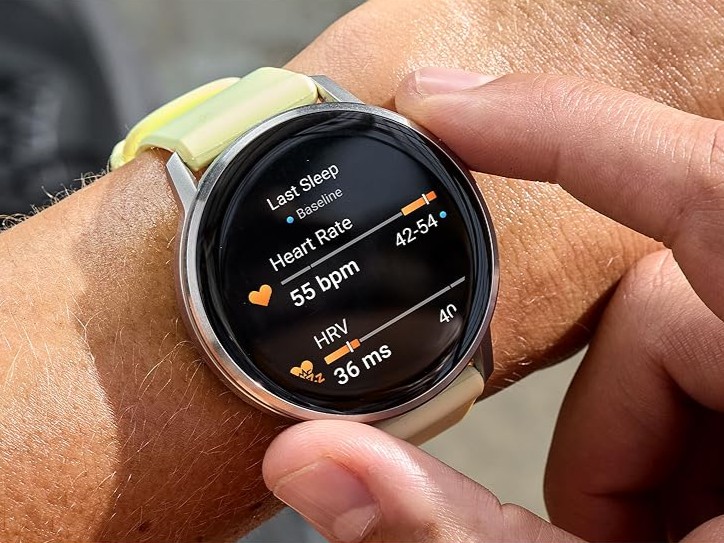
The five metrics that power Health Status each encode a different dimension of the body’s physiological response to threat. Garmin’s November 2025 press release describes the logic precisely: the feature checks whether heart rate, HRV, respiration, skin temperature, and Pulse Ox are trending away from their usual range, and interprets that cluster as a signal of added bodily stress.
HRV falls first — the autonomic nervous system is among the body’s earliest responders to immune challenge, often showing suppressed parasympathetic activity 24–48 hours before any conscious symptom appears. Resting heart rate and respiration rate follow as the sympathetic system ramps up to support the immune response. Skin temperature rises as the inflammatory process begins. SpO₂ drops if the respiratory system comes under strain.
The critical design decision Garmin made is to read these five as a cluster rather than individually. T3’s coverage of the Health Status rollout explains why this matters: a dip in HRV alone might reflect a hard training session or a late night. A dip in HRV alongside elevated skin temperature and rising resting heart rate is a meaningfully different signal. The cluster approach dramatically reduces the false positives that make single-metric stress alerts so easy to dismiss.
“Instead of looking at these metrics separately, your watch interprets them as a cluster of signals that may show your body is under extra strain.” — T3, 2025
The five Health Status metrics:
HRV — Parasympathetic recovery overnight. Drops early during immune response — often 24–48 hrs before symptoms. Flags: illness + training load.
Resting heart rate — Rises when the body works harder than usual — infection, dehydration, or accumulated stress. Flags: illness + training load.
Respiration rate — Increases with respiratory infection or elevated sympathetic drive. Flags: illness.
Skin temperature — Rises with fever or immune activation. One of the earliest physiological signals of incoming illness. Flags: illness.
Pulse Ox (SpO₂) — Oxygen saturation during sleep. Falls with respiratory illness, sleep apnoea, or high altitude. Flags: illness.
The limits of what Health Status can and cannot detect
Health Status doesn’t diagnose illness. It detects physiological deviation from your baseline — and as we covered in Five Things Your Wearable Stress Score Isn’t Telling You, several non-illness confounders (alcohol, intense training, heat, sleep timing disruption) produce similar patterns in individual metrics. The cluster approach reduces but doesn’t eliminate this ambiguity.
What the feature provides is something more valuable than a diagnosis: it gives your nervous system a voice before symptoms give you one. A Health Status alert two days before a cold fully develops is enough lead time to reduce training load, prioritise sleep, and give the immune response the physiological conditions it needs to resolve faster.
Garmin currently supports Health Status on the Fenix 8, Forerunner 570 and 970, Venu X1, vívoactive 6, and select Edge cycling computers. In our full device comparison, Garmin’s nocturnal HRV accuracy scored 0.87 CCC against ECG reference — lower than Oura’s 0.99 — which means the individual metric readings feeding Health Status carry some noise. But the cluster logic, applied to personal baselines rather than population norms, still makes it one of the most practically useful early-warning systems any wrist-worn device currently offers.
Leave a Reply