Your nervous system is always choosing a state. Meditation gives you a hand in that conversation.
Most of us spend more time than we should in sympathetic activation — the branch of the autonomic nervous system (ANS) designed for emergencies. Deadlines, notifications, and low-grade social anxiety all register as mild threats, keeping the body in a low-level state of readiness that was never meant to be permanent. Guided meditation works, in part, by giving the nervous system a deliberate off-ramp.
Two systems, one dial
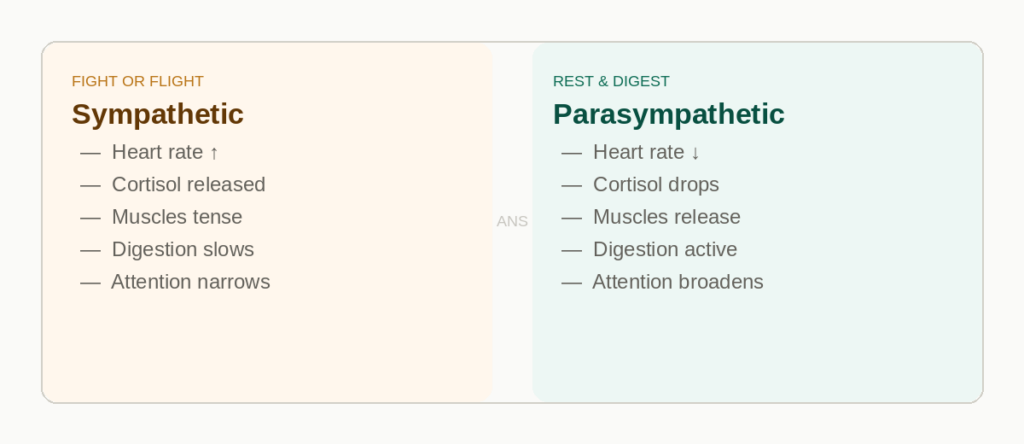
The ANS runs without your permission. It governs heart rate, digestion, hormone release, and dozens of other functions you never consciously manage. Its two main branches — sympathetic and parasympathetic — aren’t simply on/off switches. They exist in a dynamic balance, with one or the other predominating depending on what the brain perceives as the situation’s demands.
The sympathetic branch mobilises resources: it raises heart rate, floods the body with adrenaline and cortisol, redirects blood to the muscles, and sharpens short-range focus. The parasympathetic branch — often called “rest and digest” — does the opposite. It slows the heart, activates digestion, lowers blood pressure, and creates the conditions in which the body can repair itself.
“The breath is the only autonomic function you can also control voluntarily — and that makes it the clearest lever into the nervous system.”
How meditation reaches the ANS
Guided meditation influences the nervous system through several overlapping mechanisms. The most direct is the breath. Slow, extended exhales activate the vagus nerve — the long wandering nerve that is the primary driver of parasympathetic tone. When a meditation guide asks you to lengthen your out-breath, they’re essentially asking you to manually apply the brake pedal of your stress response.
Body scan techniques work through a different route. By directing attention systematically through the body, they reduce the activity of the default mode network — the part of the brain associated with rumination and self-referential thinking — while simultaneously signalling to the motor cortex that no physical action is required. Tension releases. The body interprets this as safety.
Visualisation and voice pacing add another layer. A calm, measured voice acts as a social safety cue. The brain interprets prosody — the rhythm and tone of speech — as environmental information. Slow, low vocal delivery says: no threat here.
The three phases of a state shift
What makes guided meditation particularly useful is that it doesn’t require you to believe it’s working. The physiological cascade — slower breath, lower cortisol, reduced muscle tension — unfolds whether or not your mind is cooperating. The nervous system responds to input, not intention. Give it the right conditions and it will move.
Over time, and with repeated practice, the window between trigger and response widens. The sympathetic system still fires — that’s its job — but the return to baseline becomes faster, more reliable, and increasingly something you can influence on purpose.